



Maya and Its Role in the Philippines Online Betting Market
Maya sits at an important intersection between digital payments and online betting. Its role is no longer simply about moving money quickly: Regulation, wallet controls, identity checks, and changing payment arrangements now shape how Maya can appear around gaming services.
Maya in the Digital Betting Payment Landscape
Maya is a financial service, not a betting operator. Maya Philippines, Inc. is licensed by the Bangko Sentral ng Pilipinas (BSP) as an electronic money issuer and operator of payment systems. A Maya Account stores Philippine Peso value and can be used for transfers, online payments, merchant transactions, and other supported services.
That distinction matters. When someone sees Maya beside a gaming cashier, it is easy to treat the wallet and the gaming service as part of the same product. They are not.
Maya Wallet Inside a Wider Payment Routine
A typical Maya user may receive money, cash in, pay bills, buy online, transfer funds, or use a card from the same account. Betting-related payments therefore sit inside a much larger financial routine.
For example, someone may keep PHP 4,000 in Maya for transport, food, subscriptions, and weekend spending. A gaming transaction is only one possible use of that balance. From a payments perspective, this makes spending controls and clear transaction records far more important than simply having a fast checkout screen.
Payment Service, Not Gaming Operator
Maya does not set casino odds, manage game results, or determine betting rules. Those responsibilities belong to gaming operators.
Its role is financial: Handling supported payment functions while complying with BSP requirements, merchant rules, anti-money laundering controls, and its own terms of service.
That role became considerably clearer after 2025.
E-Wallet Betting Access Changed in 2025
For years, convenience drove much of the discussion around Philippine e-wallets. A few taps could move a user from an everyday payment app toward numerous digital services.

E-Wallet Betting Access Changed in 2025
Online gambling became part of the regulatory debate surrounding that convenience.
On August 14, 2025, the BSP issued Memorandum No. M-2025-029 ordering BSP-supervised institutions to remove links that provided direct in-app access to gambling services from mobile payment applications and websites. The order specifically covered links that redirected account holders to gaming or gambling services.
Direct Gambling Access Was Delinked
This change is more precise than saying, “Maya no longer works with betting.”
The important distinction is between:
- A gambling link embedded inside a payment app
- A wallet or card being offered through an external merchant payment flow
- A gaming operator displaying a particular payment method in its cashier
- A transaction being accepted under the payment provider’s current rules
These are not interchangeable.
PAGCOR later described the delinking of e-wallets and certain payment channels as part of tighter financial safeguards for digital gaming. It linked the change with stronger transaction traceability, anti-money laundering protection, and greater protection for users.
Old Screenshots Can Be Misleading
This is where outdated betting articles become unreliable.
A screenshot from early 2025 might show an e-wallet shortcut, gaming icon, or direct route that no longer exists. Seeing Maya mentioned in an old tutorial does not confirm that the same payment arrangement is available today.
For anyone checking Maya in relation to online betting, the date of the information now matters almost as much as the payment method itself.
Digital Payments and the Online Gaming Economy
Online betting depends on more than game selection. Money must enter and leave the ecosystem through channels that can identify transactions, apply limits, detect unusual activity, and comply with financial rules.
That gives payment services an unusually important position.
A smooth payment flow can feel almost invisible when everything works. A delayed withdrawal, mismatched account name, unavailable channel, or changed wallet policy quickly reminds users how much the gaming experience depends on financial infrastructure.
Convenience Now Comes With More Controls
Digital payments are valued because they reduce friction. Yet regulators increasingly care about exactly where that friction should remain.
Some extra steps have a purpose:
- Identity verification connects an account with a real user.
- Transaction records improve traceability.
- Merchant controls help financial institutions identify where money is going.
- Payment restrictions can limit unsupported or higher-risk transactions.
- Account limits reduce unrestricted movement of funds.
There is a practical balance here. Fast payments remain useful, but instant access cannot be the only measure of a good payment system.
Maya Wallet, Cards, and Merchant Payments
Maya should not be treated as one single payment rail.
A user may interact with Maya through a wallet balance, online merchant payment, QR transaction, transfer, or card. Maya’s business infrastructure also supports merchant acceptance across different payment channels.
That creates an important lesson for betting payments: Seeing one Maya-related option does not mean every Maya product can be used in the same way.
Wallet and Card Transactions Are Different
Suppose a gaming cashier accepts a card issued through the Maya ecosystem but does not show a direct Maya Wallet option. That is a different payment arrangement from a dedicated wallet integration.
The same applies in reverse.
A merchant may support one route while another is unavailable because payment acceptance depends on factors including merchant accreditation, transaction classification, current provider policies, and financial regulation.
A familiar payment logo should be treated as the beginning of the check, not proof that every deposit and withdrawal route is available.
Deposit and Withdrawal Routes May Not Match
Another common assumption is that money must leave through the same channel used to fund an account.
That is not always the case. Gaming operators can maintain separate rules for deposits and withdrawals, particularly where identity checks, merchant arrangements, or account verification requirements differ.
This is worth checking before funds are moved, not afterward.
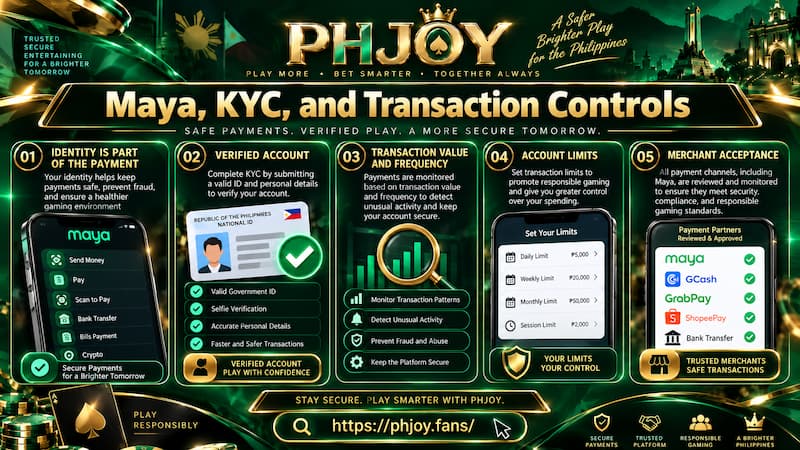
Maya, KYC, and Transaction Controls
Maya operates inside a regulated financial environment. Its accounts and payment services are therefore subject to controls that have little to do with whether a transaction feels convenient.
Know Your Customer procedures are one example. An account attached to verified identity information gives financial institutions a clearer basis for monitoring activity and responding to suspicious transactions.
Maya, KYC, and Transaction Controls
Identity Is Part of the Payment
Before sharing identity or payment information with PHJOY, users can also review its privacy policy to understand how account information is handled.
Details that can matter include:
- The identity registered to the wallet.
- The merchant receiving the payment.
- Transaction value and frequency.
- Applicable account or payment limits.
- The financial institution’s current rules for that merchant category.
A payment failing does not automatically mean Maya is experiencing a technical outage. The reason could sit anywhere between merchant acceptance, account status, limits, compliance checks, or a change in supported payment arrangements.
Maya and PHJOY Payments
For PHJOY, Maya should be treated as a payment method that requires current verification rather than assumed availability.
If Maya appears in the cashier, check the actual transaction details presented at that moment. Payment menus can change, and a method available for deposits may not necessarily appear for withdrawals.
Check the Current Cashier Before Moving Money
A sensible payment check takes less than a minute:
- Confirm that Maya is currently displayed.
- Read the minimum and maximum transaction amounts.
- Check whether fees are shown.
- Confirm whether the recipient is a recognized merchant or payment processor.
- Review the withdrawal methods separately.
- Avoid relying on old social posts or screenshots.
This is more useful than memorizing a generic “Maya deposit guide” because payment arrangements can change without the rest of a gaming service changing at all.
A More Controlled Role for Maya
The relationship between e-wallets and online betting has matured quickly.
A few years ago, the conversation focused heavily on speed: Open an app, move funds, continue. The regulatory direction since 2025 puts far more emphasis on separation between payment services and direct gambling access.
That does not make Maya irrelevant. It changes where its relevance sits.
Payment Infrastructure Instead of Gambling Access
Maya remains part of a broad digital payments ecosystem regulated by the BSP. What has changed is the expectation that an e-wallet should not double as a direct doorway into gambling services.
That separation is significant. It keeps the financial account centered on payments while putting responsibility on licensed gaming operators to maintain their own compliant access, verification, and payment arrangements.
For users, the result is straightforward: Maya availability should be checked transaction by transaction rather than assumed from its popularity as an e-wallet.
Maya in a More Regulated Betting Market
Maya’s role in online betting is best understood through payments, not promotions. It can provide familiar digital financial infrastructure, but current access depends on regulation, merchant arrangements, account status, and the payment options offered by each operator.
The 2025 removal of direct in-app gambling links marked a clear change in that relationship. Maya remains relevant, yet the connection between an e-wallet and online gaming is now more controlled, more visible, and more dependent on proper verification.
For PHJOY or any other gaming service, checking the current cashier, withdrawal conditions, and account requirements is more reliable than trusting an old payment list. In a market that changes this quickly, accurate payment information is useful precisely because it does not pretend yesterday’s setup is guaranteed to work today.