



Why the Discard Pile Matters in Tongits
Discard Pile in Tongits is not simply where unwanted cards go. It affects which cards can be taken, which melds become visible and how much information passes around the table. Reading it well helps you protect your hand, reduce deadwood and avoid giving the next player an easy opening.
Discard Pile in Tongits Rules
Every turn revolves around a simple choice: Draw from the face-down stock or take the card sitting on top of the discard pile.
That second option comes with a condition. In standard Tongits rules, you may take the top discard only when you can combine it with at least two cards already in your hand to form a new valid meld. The new meld must then be exposed on the table.
A valid meld can be:
- A set of three or four cards of the same rank.
- A run of at least three consecutive cards from the same suit.
You cannot dig deeper into the pile for an older card. Only the current top card is available.
Taking the Top Discard
Suppose the player before you throws 7♥.
If your hand contains 5♥ and 6♥, the discard is immediately useful. You can pick up 7♥ and expose 5♥–6♥–7♥ as a run.
If you hold only 6♥ and hope to find 5♥ later, that is not enough. The discard must complete a valid meld now, not create a possibility for a future turn.
The Immediate Meld Requirement
This rule changes the meaning of every face-up card. A discard is not another free draw option. Taking it commits you to revealing part of your hand.
There is another important distinction: You cannot take a discarded card just to add it to an existing exposed meld through sapaw. The discard must form a new set or run using at least two cards from your hand.
That makes discard pickups unusually informative. When someone takes your card, you immediately learn something concrete about the structure of that hand.
Reading Information From the Discard Pile
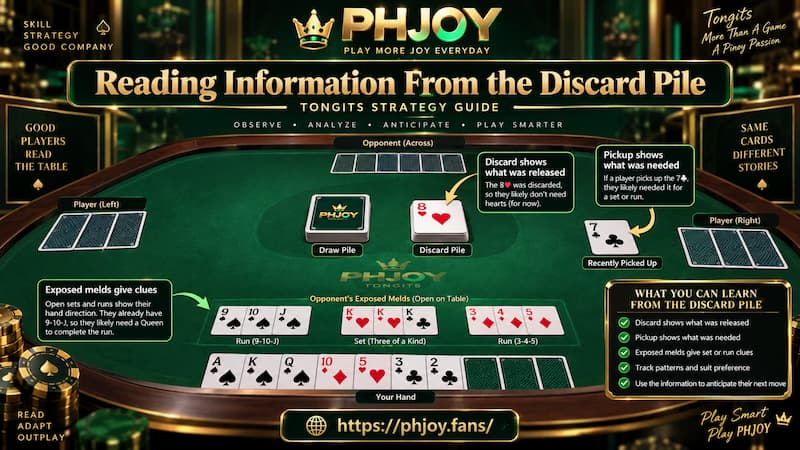
Tongits gives you incomplete information, but the discard pile keeps leaving clues in plain sight.
A single throw rarely tells the whole story. A sequence of throws can.
If an opponent repeatedly releases clubs, for example, building a long club run may be less likely for that player. If several 9s have already appeared between melds and discards, holding an isolated 9 for a possible three-of-a-kind becomes less attractive.
None of those observations should be treated as certainty. They are pieces of evidence.
Reading Information From the Discard Pile
Opponent Discards
Watch for patterns rather than isolated cards.
Useful details include:
- Ranks an opponent keeps throwing.
- Suits disappearing rapidly from the table.
- Middle cards such as 6, 7 and 8 that could connect several possible runs.
- High cards released early despite their 10-point deadwood value.
- Cards discarded immediately after drawing from the stock.
Imagine seeing 4♠ and 6♠ leave the same opponent’s hand during separate turns. Throwing 5♠ later may feel safer than it would have several turns earlier, although another player could still need it.
The discard history narrows possibilities. It never eliminates the need to check the whole table.
Pickups Reveal More Than Throws
A pickup provides stronger information because the player must expose the new meld immediately.
If 8♣ is discarded and the next player takes it to expose 8♣–8♥–8♦, you now know that rank matters around that hand.
If the same 8♣ instead completes 6♣–7♣–8♣, nearby clubs become more sensitive. A future 5♣ or 9♣ may extend that structure through sapaw.
A discard tells you what someone was willing to lose. A pickup shows you exactly why someone wanted a card.
That difference is central to strong table reading.
Choosing a Safer Discard
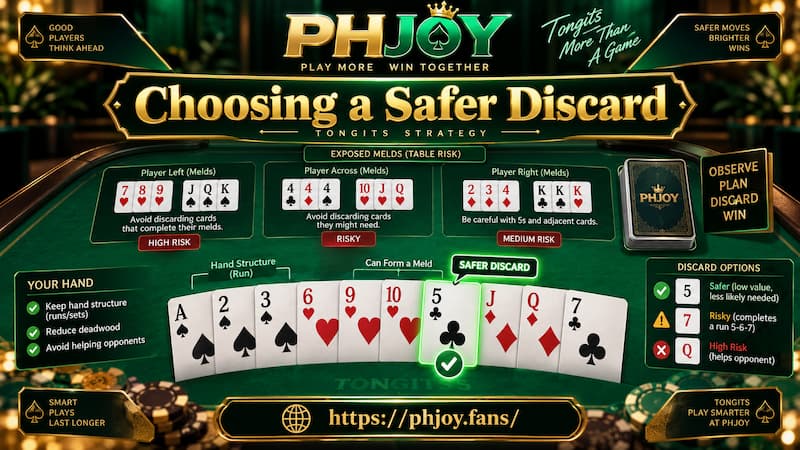
Discarding the card you personally need least is not always the best move.
Every throw has two sides: How much does the card hurt your own hand if you keep it, and how much could it help the player sitting next to you if you release it?
Good discard play balances both.
Choosing a Safer Discard
Protecting Useful Hand Structure
Cards with several paths into a meld deserve more patience than isolated cards.
Suppose your hand contains 5♥, 6♥ and K♣.
The king carries more deadwood, but the important difference is flexibility. The 5♥ and 6♥ can work with 4♥ or 7♥, while K♣ may have no nearby support at all.
That makes the king a natural discard candidate unless visible information suggests that an opponent is collecting kings.
The same logic applies in reverse. A low-value card is not automatically worth keeping merely because its point cost is small.
Deadwood Versus Table Risk
Tongits scoring gives aces a value of 1, numbered cards their face value and Jacks, Queens and Kings a value of 10 when unmatched cards are counted.
That naturally makes high cards uncomfortable.
Still, automatically throwing every unmatched face card can become predictable and expensive. If a player has already exposed Q♣–Q♦–Q♥, releasing Q♠ may hand over an easy sapaw opportunity. A different discard may preserve more control.
Before throwing, use a short check:
- Look at every exposed meld.
- Recall the last few cards opponents picked up.
- Check whether your discard connects to nearby ranks or suits.
- Compare that danger with the deadwood you would keep instead.
- Choose the card that leaves your hand healthier without creating an obvious gift.
This takes only a few seconds once the habit becomes automatic.
Discard Decisions Across the Round
The meaning of a discard changes as information accumulates.
Early Play
Early in the round, the table has revealed very little. Avoid inventing a strong read from one or two cards.
Flexible middle cards often deserve extra attention because they can connect in both directions. A 7♥ can potentially join 5♥–6♥, 6♥–8♥, or 8♥–9♥ structures depending on the rest of the hand.
That does not mean every 7 should be kept. It means its usefulness should be judged by connections rather than point value alone.
Middle Play
Once several melds are exposed, discard choices become more precise.
You can start separating cards into three practical groups:
- Cards useful to your own developing hand.
- Cards that appear relatively neutral.
- Cards that may directly strengthen an opponent’s visible structure.
This is where memory begins paying off. A card that looked harmless three turns ago may become dangerous after a new pickup exposes the direction of an opponent’s hand.
Late Play
Late in a round, immediate consequences carry more weight.
The stock may be running low. Hands are smaller. More melds are visible. Giving away one usable card can change the position quickly.
If the stock is exhausted, opened players compare the point value of unmatched cards, with the lowest total winning under standard rules.
At that stage, protecting a speculative combination can be less valuable than dumping 10 points of deadwood. The balance shifts from building possibilities toward controlling the final hand.
Common Discard Mistakes
Some losses begin long before the final card.
Throwing the Highest Card Automatically
A king worth 10 points looks ugly in the hand, but its point value is only one part of the decision. Check whether throwing it completes something obvious for the next player.
Watching Only Your Own Cards
Tongits is not solitaire. Exposed melds, pickups and recent discards all affect the value of the card in your hand.
Ignoring the table means making decisions with information that was freely available.
Treating One Discard as Proof
An opponent throwing one 10 does not mean every 10 is safe.
Hands change after every draw. New cards create new combinations. Reads should be updated rather than treated as permanent conclusions.
Taking Every Legal Discard
A legal pickup can still be strategically weak.
Taking a discard forces you to expose the new meld, revealing part of your hand. Sometimes drawing blindly from the stock preserves more flexibility and keeps opponents guessing.
The question is not simply, “Can I take this card?” It is whether the completed meld is valuable enough to justify revealing it.
Discard Play in PHJOY Tongits
The same table discipline carries into online play. When playing Tongits through PHJOY, visible melds and recent discard activity should influence each decision just as strongly as the cards in your own hand.
PHP stakes do not change card logic. Whether the table uses a small or larger Peso amount, a discard still has to be judged by its ability to complete melds, reduce deadwood or feed another hand.
Online rounds can feel faster, which makes careless throwing easier. A simple routine helps: Check the exposed cards before confirming every discard. That extra glance often catches a connection that was easy to miss while concentrating on your own combinations.
One Discard Can Shape Several Turns
The Discard Pile in Tongits connects offense, defense and information in one place.
Every card thrown away tells opponents something. Every pickup reveals even more. Strong play comes from treating those actions as part of the hand rather than background activity.
Before releasing a card, look beyond its point value. Check your remaining combinations, exposed melds and recent pickups. The best discard is not always the card you want least. Often, it is the card that weakens your hand the least while giving everyone else as little as possible.