



How Penalty Betting Works in Football Markets
Penalty Betting covers wagers tied to penalties awarded, scored, missed, or taken in a shootout. The goal here is simple: Separate these markets clearly, explain how settlement works, and show where VAR, stoppage time, extra time, and shootouts can change the result.
Penalty Betting Starts With the Market Wording
A penalty looks like one event on the pitch. In betting, it can produce several completely different markets.
That distinction matters. A bettor may correctly predict that a penalty will occur and still lose because the selected market required the penalty to be scored. Another selection may only require the referee to award the kick.
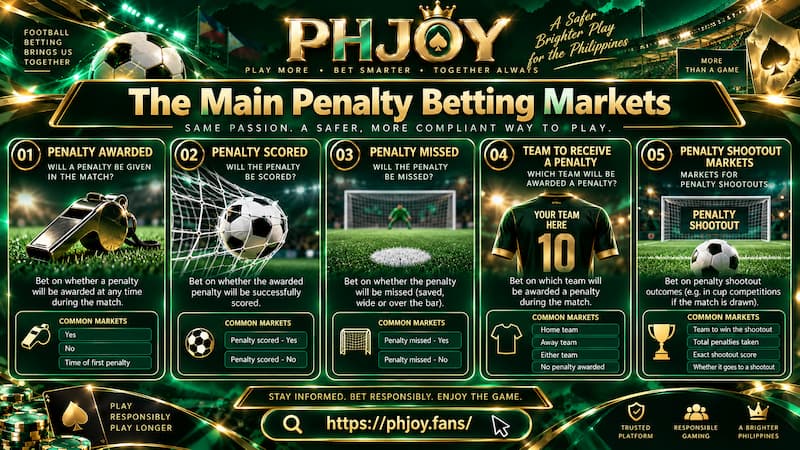
Common Penalty Betting markets include:
- Penalty to be awarded: Usually concerned with whether the referee gives at least one qualifying penalty.
- Penalty to be scored: The kick must result in a goal under the market’s settlement rules.
- Penalty to be missed: The relevant kick must fail to produce a goal.
- Team to receive a penalty: Only penalties awarded to the named team count.
- Penalty shootout markets: These apply specifically to kicks taken after the match has finished.
The words “awarded,” “taken,” “scored,” and “missed” should never be treated as interchangeable.
Awarded and Scored Are Different Outcomes
Consider an 87th-minute handball. The referee points to the spot, VAR confirms the decision, but the goalkeeper saves the kick.
A market asking whether a penalty is awarded may already have its qualifying event. A market asking whether a penalty is scored has a different result.
Some sportsbook rules explicitly make this distinction. For example, bet365 states that its “A Penalty in the Match” market is settled as Yes when a penalty is awarded regardless of whether it is scored or missed, while separate score/miss markets depend on the outcome of the kick.
Read the Selection Literally
This is one of the simplest habits in Penalty Betting and one of the most useful.
Do not read “Penalty: Yes” and mentally convert it into “someone will score from the spot.” First establish what the market is measuring.
The Main Penalty Betting Markets
Penalty markets often appear as small side markets beside match result, goals, cards, or corners. Their apparent simplicity can be misleading because settlement depends on a very specific event.
The Main Penalty Betting Markets
Penalty in the Match
This is normally a Yes/No market asking whether a qualifying penalty occurs during the specified period.
The important detail is the betting period. A penalty in the 93rd minute may still fall inside a standard 90-minute market because stoppage time belongs to the second half. A shootout kick after extra time is different.
VAR also matters. If the referee initially awards a penalty but reverses the call after review, major sportsbook rulebooks may treat the original award as cancelled rather than a qualifying penalty.
Team Penalty Markets
A market can narrow the condition to one team.
For example:
- Team A to be awarded a penalty.
- Team A to score a penalty.
- Team A to miss a penalty.
Those three selections could produce three different results from the same incident.
If Team A receives a penalty and scores it, the first two conditions may be satisfied. If the goalkeeper saves it, the awarded market and missed market may qualify instead, depending on the sportsbook’s precise rules.
Penalty Scored or Missed
Score/miss betting focuses on the execution of the kick rather than simply the referee’s decision.
This becomes more technical when the kick is invalidated or retaken. Football law contains situations where an infringement leads to a retake rather than a straightforward goal or miss. The 2026/27 Laws also clarify accidental double-touch situations by the kicker.
That is why the final official outcome matters more than the first thing you see on screen.
Settlement Rules Decide the Bet
The strongest Penalty Betting analysis can still fail if the bettor misunderstands the settlement period.
Before assessing probability, identify exactly when the market begins and ends.
Normal Time and Stoppage Time
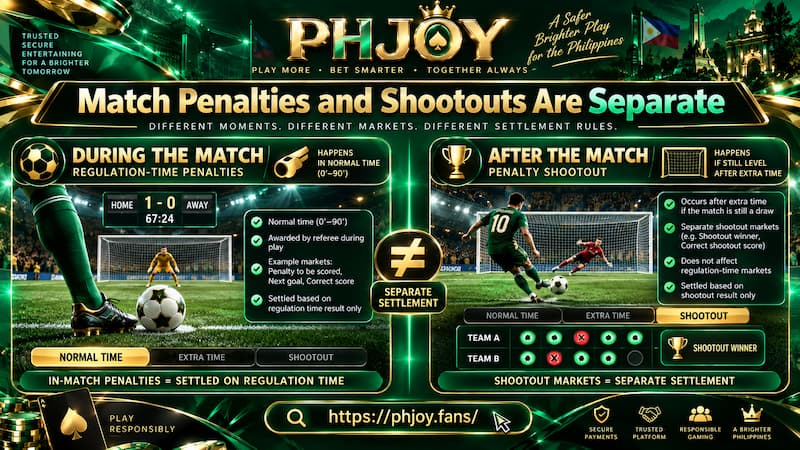
In football betting, “90 minutes” generally refers to the two regulation halves plus referee-added stoppage time. It normally does not include extra time or a penalty shootout unless the market says otherwise.
Suppose a knockout match is 1-1 after 90 minutes:
- Penalty awarded at 90+5: Normally part of regulation-time settlement.
- Penalty awarded in the 108th minute: Part of extra time.
- Kick taken in the shootout: Part of the shootout, not normal match play.
This separation is especially important in cup football.
The 2022 World Cup final is a useful real-match example. Penalty kicks occurred during the match itself, and the game was later decided by a shootout. From a betting perspective, those are not automatically one continuous penalty market.
VAR Can Change a Penalty Market
VAR creates a second layer of uncertainty because the initial referee signal may not be the final decision.
A practical sequence looks like this:
- The referee awards a penalty.
- VAR checks the incident.
- The referee either confirms or overturns the decision.
- Settlement follows the final recognized decision under the sportsbook’s rules.
A raised referee arm is not always the end of the betting event. With VAR, the confirmed decision is the safer reference point.
Different operators can word settlement rules differently, so the house rules still take priority. Some explicitly settle penalty markets according to the referee’s decision time and VAR outcome.
Retaken Penalties Need Extra Attention
A saved penalty is not always immediately a settled “miss.”
If an infringement requires the kick to be retaken, football law can effectively erase the first execution for match purposes. Goalkeeper offences, player encroachment, or certain kicking infringements can produce a retake under Law 14.
Football Rules and Betting Rules Are Not Identical
IFAB determines what happens in the match. The sportsbook determines how its market is settled.
That distinction prevents a common mistake: Assuming that knowing the Laws of the Game automatically tells you how every betting market will be graded.
Match Penalties and Shootouts Are Separate
A penalty shootout may look identical from the camera angle: Ball on the spot, one kicker, one goalkeeper.
Match Penalties and Shootouts Are Separate
Legally and for betting purposes, however, it is a separate phase.
IFAB Law 10 states that a penalty shootout takes place after the match has ended. Both teams normally take up to five alternating kicks, with the shootout ending early if one side can no longer catch the other. If the score remains level after five each, kicks continue until one team leads after an equal number of attempts.
Shootout Markets
Dedicated markets can include:
- Shootout winner
- Total penalties scored
- Next penalty scored or missed
- Last penalty scored or missed
- Shootout to reach sudden death
A standard match-time penalty bet should not be assumed to include these kicks.
Some sportsbook rulebooks explicitly exclude shootout kicks from normal “score a penalty” and “miss a penalty” settlement.
Sudden Death Does Not Always Mean Kick Number 11
Five kicks per team is the scheduled opening sequence, but a shootout can finish before all ten are taken.
If it is level after five kicks each, the next phase works in pairs: One team kicks, then the other. If one scores and the other misses within that equal round, the shootout ends.
Reading Penalty Markets at PHJOY
When PHJOY lists sports betting options for football, the useful approach is to start with the exact condition rather than the odds.
Before staking PHP, check three points:
- Market event: Does the bet require a penalty to be awarded, taken, scored, or missed?
- Settlement period: Is it normal time, extra time, or a dedicated shootout market?
- House rule: How are VAR reversals, retakes, cancelled kicks, or matches without a qualifying penalty handled?
Market availability can vary from one fixture to another. A high-profile knockout match may have several penalty-related selections, while another fixture may offer only basic football markets.
That is normal. The value comes from understanding the condition that is actually available rather than searching for the same market in every match.
Evaluating a Penalty Bet Before Staking PHP
Knowing the rules prevents settlement mistakes. Choosing a sensible price requires another layer of thinking.
Penalty Frequency Is Context, Not a Forecast
A team that received several recent penalties is not automatically “due” another one. Likewise, a team with no recent penalties is not somehow protected from conceding one tonight.
Useful context can include:
- How often attackers enter the penalty area
- Defensive tackling under pressure
- Handball exposure
- Match tempo
- Scoreline and game state
- Refereeing tendencies
- VAR availability
None of these factors guarantees a penalty. They simply help frame the probability.
Price Still Matters
Suppose you estimate a penalty has roughly a 40% chance of occurring. That judgment means little until it is compared with the offered odds.
A likely event can still be a poor bet when the price is too short. A less obvious event can be more attractive when the odds compensate for the uncertainty.
That is where Penalty Betting becomes more than predicting dramatic moments. The useful question is not only “Will there be a penalty?” but also “Does the price make sense for the probability I am assigning?”
Penalty Betting Comes Down to Precise Settlement
Penalty Betting becomes much easier once four events are kept separate: A penalty awarded, a penalty taken, a penalty scored or missed, and a shootout kick.
Add the settlement period, VAR treatment, and house rules before committing PHP. That small amount of checking removes much of the confusion and leaves you evaluating the part that actually matters: Whether the available odds justify the risk.